Our why: What’s the Missing Link?
There is a moment that happens quietly in many South African homes.
A child struggles at school. Not because they are lazy or not trying hard enough. They simply learn differently. They process information differently, communicate differently, and experience the world differently. Yet schools, workplaces, and society as a whole often expect everyone to function in exactly the same way.
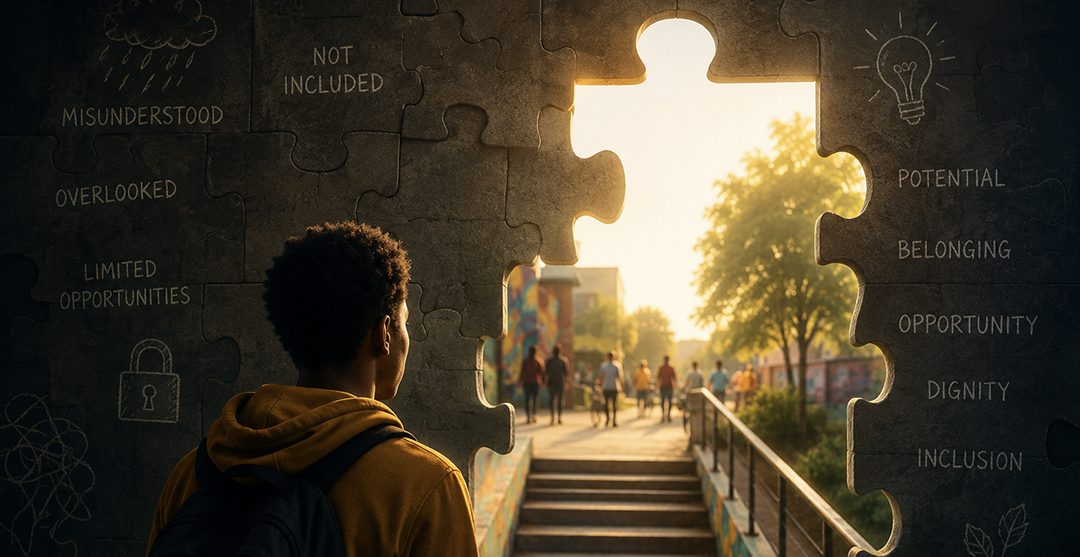
When Potential Is Misunderstood
At first, people say things like, “They’ll grow out of it.” Later, the conversations become more complicated. Teachers are overwhelmed and under-supported. Parents begin worrying about the future far earlier than most families ever have to. Young people start noticing that they are being treated differently, even if nobody says it out loud.
And somewhere along the way, expectations begin to shrink.
Not because the child has less potential, but because society often struggles to recognise potential when it looks different from what it expects. For many young people with intellectual disabilities, autism spectrum disorder, ADHD, learning disabilities, psychosocial disabilities, and other neurodiverse conditions, exclusion is not always obvious. Sometimes it is subtle. It looks like being overlooked, underestimated, or quietly left out of opportunities others take for granted. Sometimes it is people making decisions about your future before they have taken the time to understand who you are or what you are capable of.
South Africa has made important progress in recognising the rights of persons with disabilities, yet many people still face significant barriers to education, employment, transport, and community life. According to Statistics South Africa, millions of South Africans live with disabilities, with intellectual and psychosocial disabilities remaining among the most misunderstood. Behind those statistics are families trying to figure out what happens next.
The Reality Facing Families After School
For many parents, one of the hardest moments comes after school ends. Young adults leave school only to discover there are very few accessible pathways waiting for them afterwards. School provides structure, routine, support, and a sense of direction. When that falls away, the uncertainty can feel overwhelming.
Many families cannot afford private support services. Employment opportunities remain limited and public transport can feel unsafe or inaccessible for young adults trying to travel independently. Some young people spend years at home after school, watching everyone else move forward while they remain stuck in limbo.
Not because they lack ability. Because society has not created enough spaces for them to belong.
This is where The Living Link exists.
Why The Living Link Exists
We work at grassroots level with young adults who are often overlooked because their disabilities are not always immediately visible or easily understood. Many of the individuals we support have spent years being underestimated, misunderstood, or excluded from opportunities that others take for granted.
But we also see something else every single day. We see potential.
Not always the loud or obvious kind either. Sometimes it shows up in very ordinary moments. A student learning to travel independently for the first time. Someone confidently greeting customers during job sampling after struggling with anxiety for months. A young adult receiving their first pay slip and realising, perhaps for the first time, that independence might actually be possible for them.
What Inclusion Looks Like in Everyday Life
Those moments matter deeply. Because disability is not the absence of ability. More often, it is the absence of opportunity, support, and understanding. At The Living Link, inclusion is not simply a concept we speak about during awareness campaigns. It is something practical and deeply human. It exists in learning workplace etiquette, building confidence, managing conflict, developing communication skills, and navigating everyday responsibilities that many people take for granted.
It also exists in helping young people realise that they are capable of far more than society has often led them to believe.
Inclusion Is Everyone’s Responsibility
At the same time, inclusion cannot rest entirely on the shoulders of persons with disabilities. Society itself has work to do. Workplaces need to become more willing to learn and adapt. Communities need to stop viewing support as charity and start understanding it as dignity, equity, and basic human decency.
We cannot continue expecting people with disabilities to endlessly fit themselves into systems that were never designed with them in mind. Because when people are genuinely supported and understood, incredible things begin to happen. Over time, confidence grows, independence develops, and young people begin seeing possibilities for themselves that once felt completely out of reach.
Beyond Stereotypes and Assumptions
And despite the seriousness of this work, there is also a great deal of joy in it. Young people with disabilities are not fragile inspirational characters existing purely to teach life lessons to everyone else. They are funny, sarcastic, clever, stubborn, dramatic, insightful, and wonderfully honest. They tease staff members, make jokes during workshops, complain about early mornings, celebrate payday with enthusiasm, and occasionally say things so unexpectedly accurate that entire rooms burst out laughing.
And this matters because too often, disability is spoken about in extremes. People are either underestimated or placed on impossible pedestals simply for navigating life with a disability. But most people simply want the same things everyone else wants: purpose, connection, independence, belonging, and the opportunity to contribute meaningfully to the world around them.
Bridging the Gap Between Potential and Participation
That is why The Living Link exists.
Not because persons with disabilities need saving, but because society still creates barriers that make participation unnecessarily difficult. We exist to bridge that gap. To support, equip, advocate, encourage, and create opportunities for young adults to participate more fully in their communities and workplaces.
The work is not always easy. Systems fail people. Families experience burnout. Employers still need education and support. South Africa still has a long way to go in becoming truly inclusive. But every time a young person begins believing in their own future again, something powerful happens. The impact reaches far beyond the individual. Families begin feeling hopeful again. Communities become stronger and more inclusive. Expectations slowly start to shift.
At The Living Link, we hold onto a simple belief: when people are understood, supported, and given meaningful opportunities, they thrive. Not because their challenges disappear, but because every person deserves the chance to participate fully in life, to be treated with dignity, and to know that they belong. And perhaps that, is the missing link.